Mousa Batarseh Reviews
01
Public pages only
No logins, no scraping behind walls, no private data. If a shopper or a crawler can’t see it, it isn’t in the review.
Every review on this site was made this way: public pages only, every claim dated, and a working fix at the end. Here’s the whole process.
curl -s site.com/sitemap.xmlgrep -c 'application/ld+json'189 URLs · 44 redirectsobserved 2026-09-20 23:20 UTCcurl -I /llms.txt → 404[E3] 15-word templatetitle-linter.js · 59 listingsstore-page generatorspecies atlas · 300+ speciesweek 1 · templateweeks 2–3 · channelsweek 4 · speed & contentSitemap, robots, canonicals, titles, schema and prices, pulled from the public HTML the way a crawler or an answer engine sees it. Nothing behind a login.
Every finding carries the date, the URL and the check behind it, so anyone can re-run it and see if it’s been fixed. Opinions don’t go in; observations do.
A scanner, a template, a rewritten page or a working browser. Something a team can use on Monday, not a list of recommendations.
A 30/60/90 plan that puts template fixes first, because one template change usually fixes hundreds of pages at once.
Not every check runs on every site. These are the ones that found the problems in the reviews on this site.
A plain sentence that names the defect, not the category.
Where it was seen and the exact values, copied from the page or schema.
When it was observed, so it can be re-checked later.
Why a shopper, a crawler or the revenue team would care.
The smallest change that closes it, usually at the template.
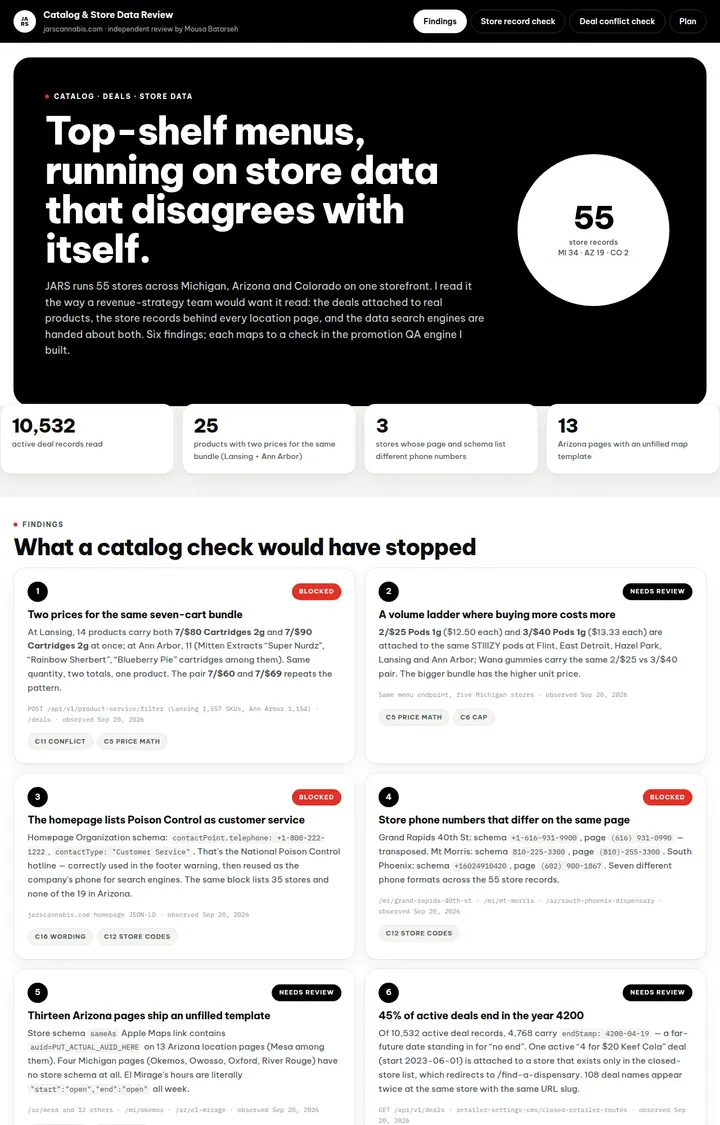
At Lansing, 14 products carry both 7/$80 Cartridges 2g and 7/$90 Cartridges 2g at once; at Ann Arbor, 11 (Mitten Extracts “Super Nurdz”, “Rainbow Sherbert”, “Blueberry Pie” cartridges among them). Same quantity, two totals, one product.
Sitemap, robots, templates, schema and prices pulled and counted.
Findings written, dated and sourced. Anything unproven is cut.
The scanner, template or working browser that proves the fix.
A 30/60/90 plan, then the review goes live as its own site.
Five things, every time. The tool is the part most reviews skip.
A standalone review site with every finding, dated.
Scanner, linter, generator or browser built for that site.
Titles, descriptions, schema or copy, ready to paste.
What to fix first, second and third.
Every claim with its date, source and re-run command.
No logins, no scraping behind walls, no private data. If a shopper or a crawler can’t see it, it isn’t in the review.
One template fix usually beats a hundred page fixes. Findings are grouped by the template that causes them.
“43 sold-out products still published” instead of “inventory issues”. Every figure is counted, not estimated.
Each claim ships with the date and the check behind it, so it can be verified or closed later.
About the reviews and how they’re made.
A short, independent study of one company’s live website. I crawl the public pages, record every finding with its date and the URL or command behind it, and build a working fix: a scanner, a template, a rewritten page or a 90-day plan.
No. Each review is unsolicited and made from public pages only. No logins, no private data, and no affiliation with the companies named.
Most are built in one to two days. The crawl and evidence come first; the prototype and the plan come after the findings are checked.
Websites change. Every number carries the date it was observed, so anyone can re-check it and a fixed issue is easy to tell apart from an open one.
Yes. Send the URL and what the site needs to do better. The first findings come back dated and sourced, with one working fix.
Send a URL. You’ll get the first findings back, dated and sourced.
Thanks. I’ll look at and reply to soon.